Practice
How can I practice WOOP?
This page offers a variety of resources to help you practice WOOP—online, at home, or on the go. Try our mobile app and let it guide you step-by-step through the WOOP process. Watch our videos to learn more about WOOP and how you can apply it to your own life. Prefer to stay offline? Download our WOOP kit and print your own set of WOOP instructions.
Download the WOOP app
Download the app! Yes - it’s free!


The WOOP app is designed to support you in your daily life. You will learn how to identify and fulfill your most important wishes. These wishes may refer to different time spans and different life domains (academics/career, health, and interpersonal relations). The app allows you to save your wishes and observe your progress. By teaching you the WOOP strategy, the app empowers you to sort out what is important in your day-to-day routine. Over time, you’ll find and achieve what you really want.
How can I use the WOOP app?
The app guides you through the four steps Wish - Outcome - Obstacle - Plan. You only need a few minutes, but you need to be focused and stick to the right order of the four steps.
The app is available in the following languages:
Afrikaans, Arabic, Chinese (simplified, traditional), Dutch, English, Farsi, French, German, Greek, IsiNdebele, isiXhosa, Italian, Japanese, Portuguese, Polish, Russian, Siswati, Setswana, Sepedi, Sesotho, Spanish, Tagalog, Tshivenḓa, Xitsonga, and Zulu.
Watch the WOOP videos
What can WOOP look like? In these two videos, you can see how Gabriele Oettingen guides two people through a WOOP and what kind of WOOP they create for themselves.
Let the WOOP kit guide you through WOOP
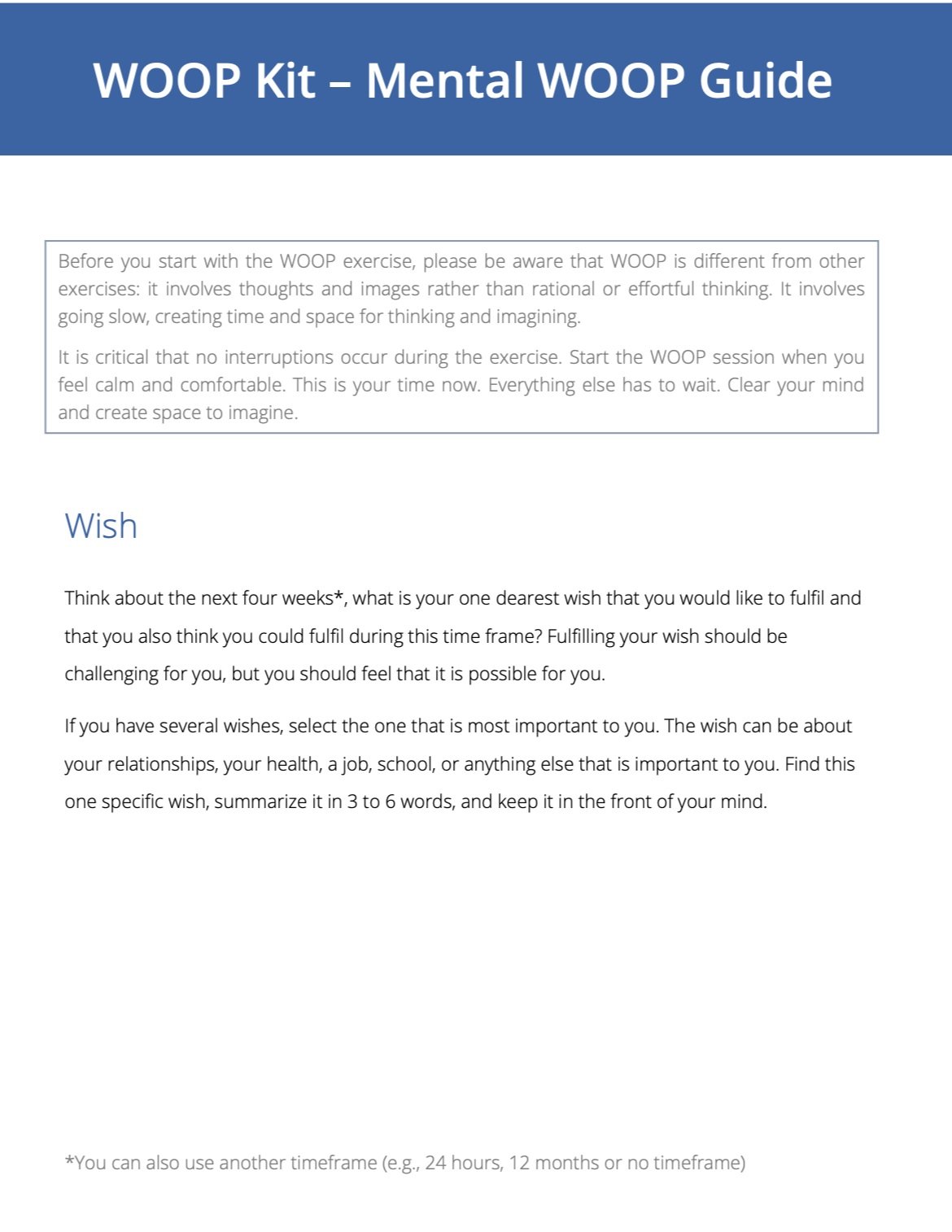
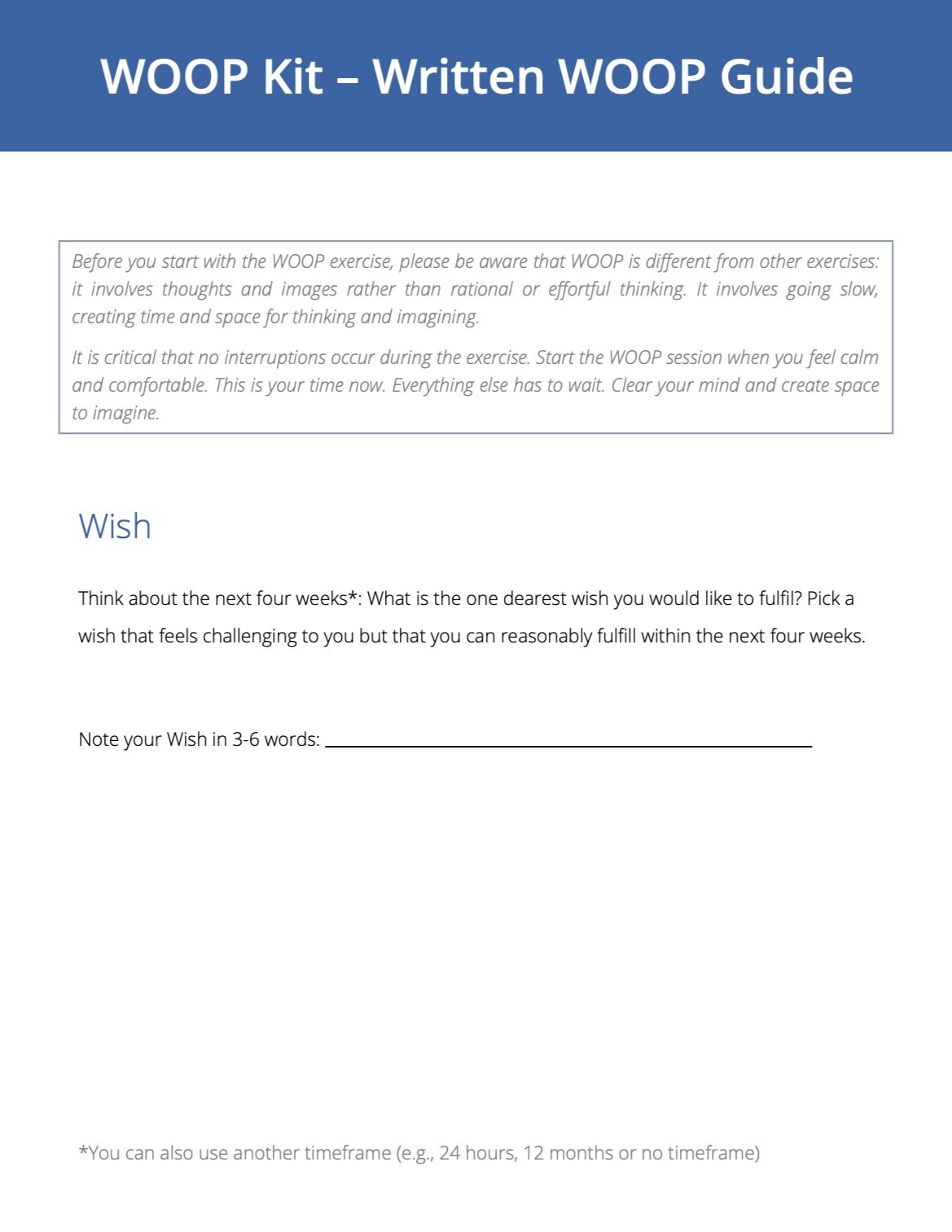
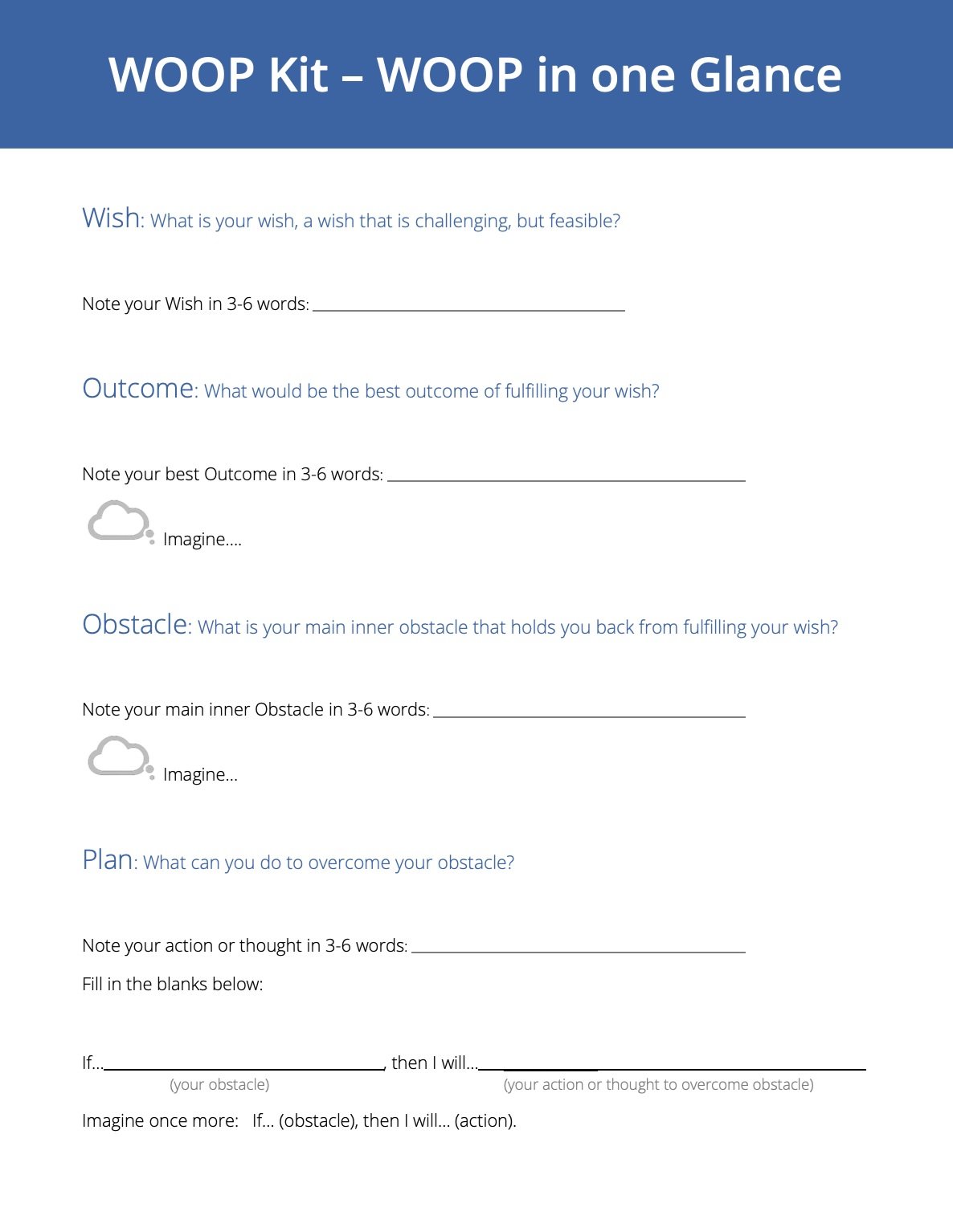
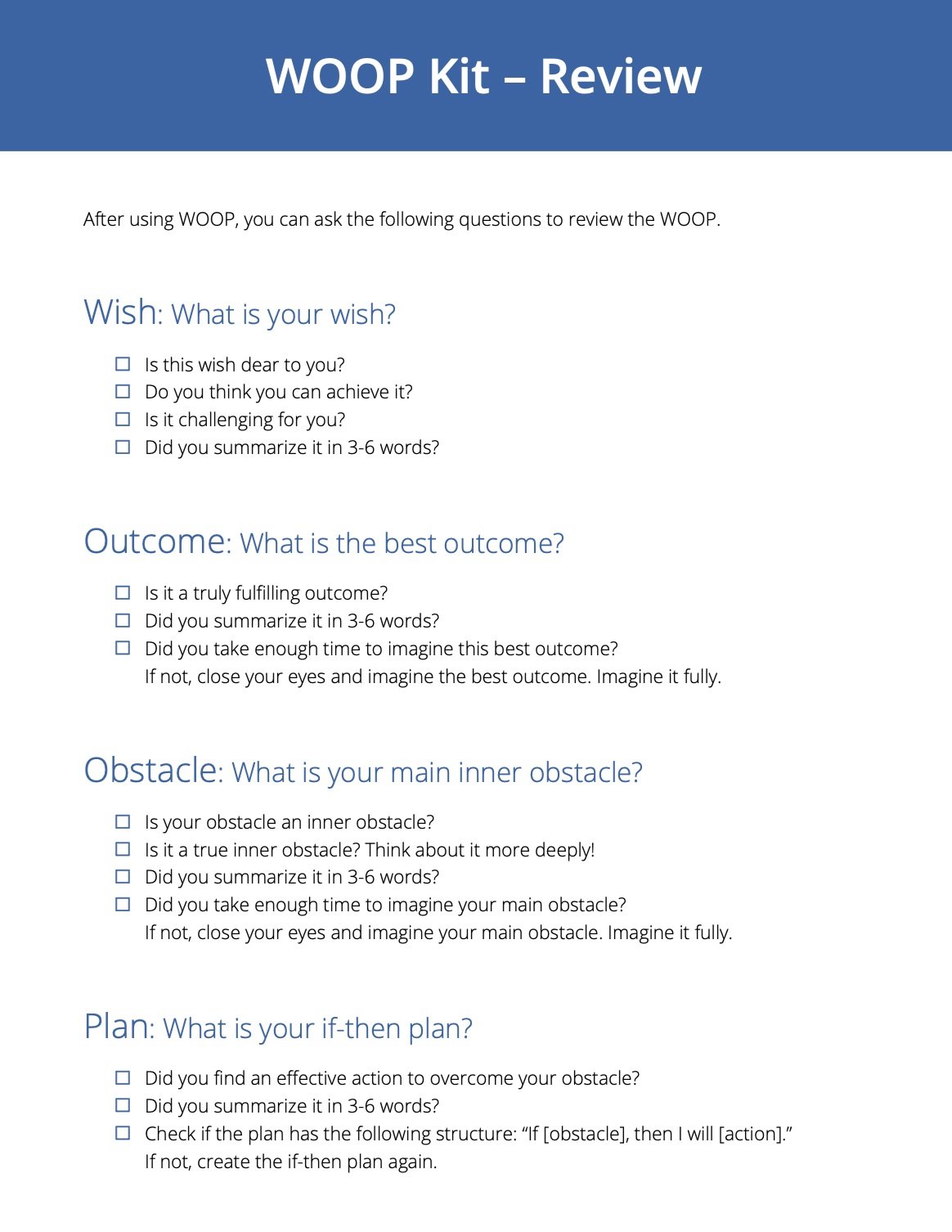
The WOOP kit provides everything you need to learn and practice WOOP in your everyday life. The WOOP kit contains seven separate documents for your personal use. You’ll find an overview of WOOP, the WOOP exercise in a mental and written format, a WOOP card that you can use as a daily reminder, a checklist, faqs and information on how to adapt your plans, and a guide for WOOP in groups.
What is included in the WOOP kit?
Mental WOOP Guide - leads you mentally through a WOOP
Written WOOP Guide - guides you through a written WOOP
WOOP in one Glance - guides you through a short, written WOOP
WOOP Review - gives advice on how to check your WOOP
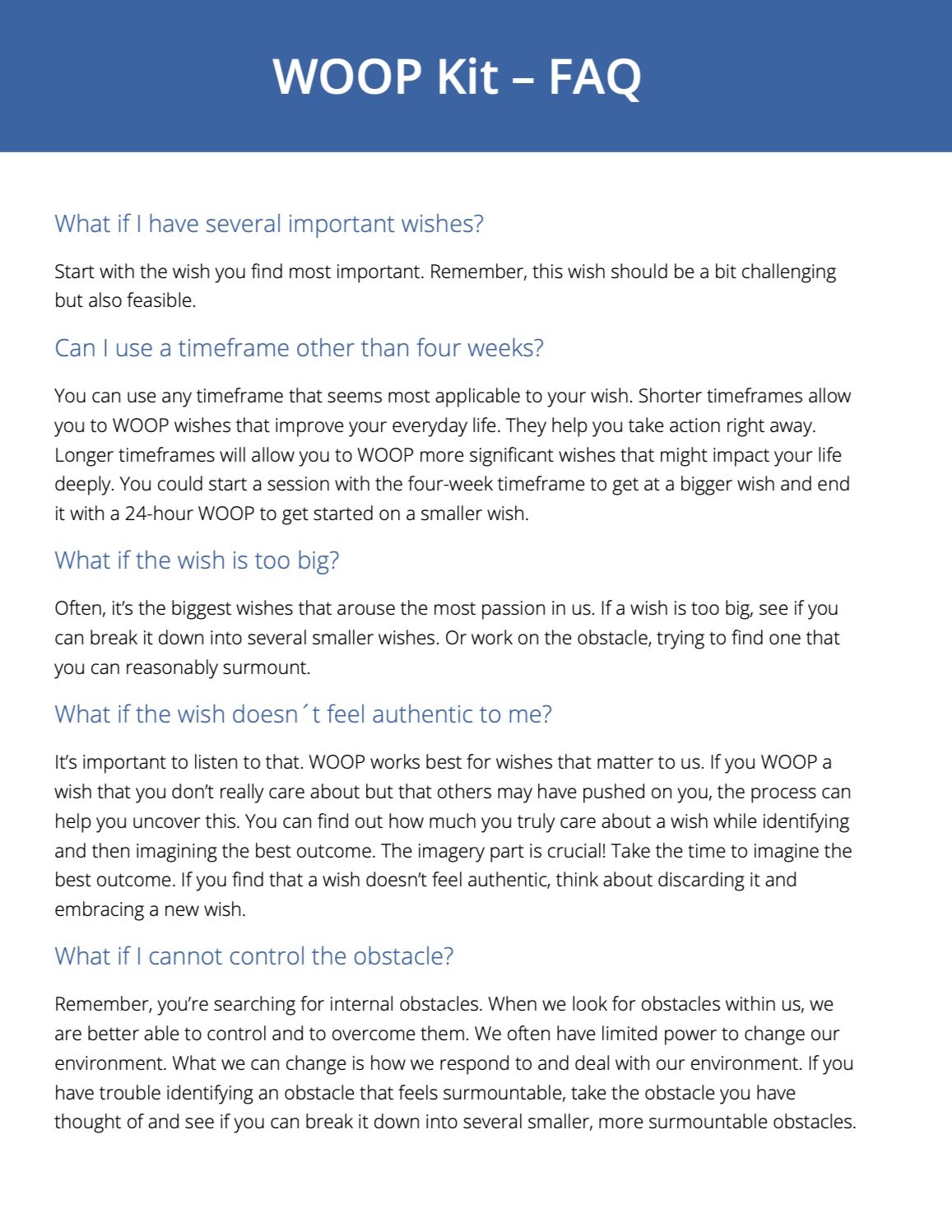
FAQ - frequently asked questions
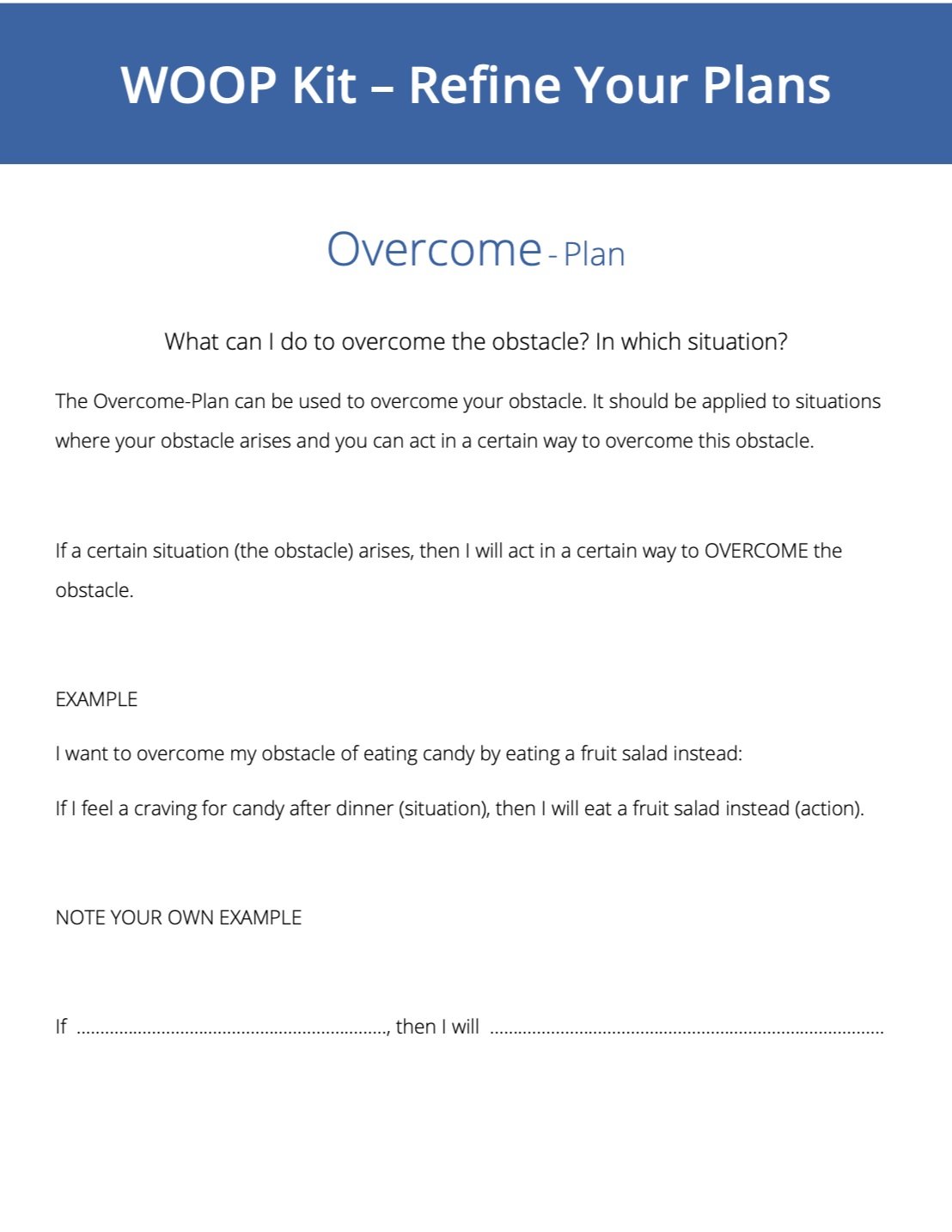
Refine Your Plans - tells you three different ways to make plans
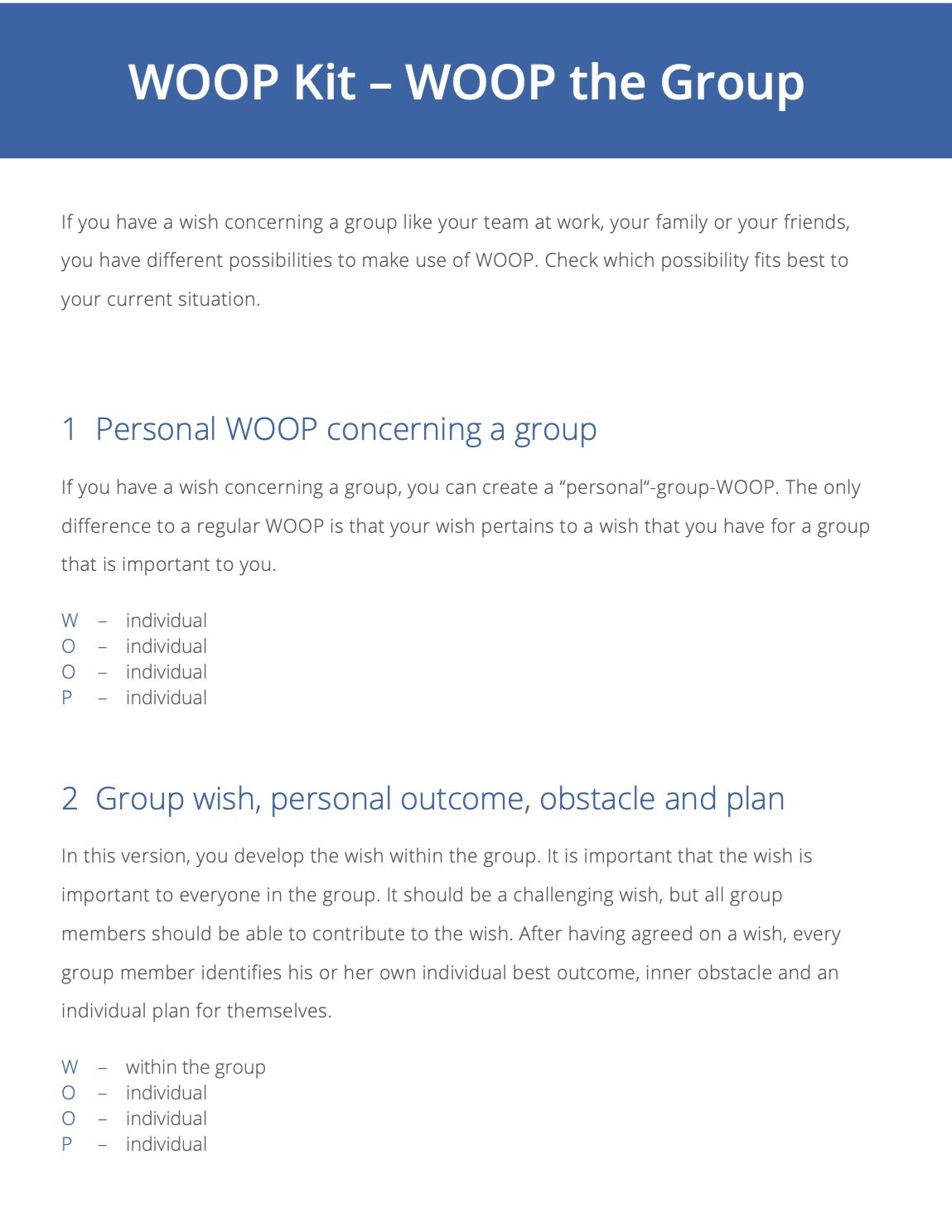
WOOP in Groups - explains how to use WOOP in groups
Voices of WOOP
“Because of this technique, I was able to transform my life.”
“I love your WOOP work-I’m sharing it wherever I go!”
“I’ve been eating much more fruit and drinking much less wine and I am wooping daily (I even have a WOOP for a daily WOOP practice)”
WOOP has been translated into many languages and is used in over 100 countries worldwide. On this page, you can learn about people's experiences with WOOP.
Frequently asked questions
PREPARE YOUR WOOP
-
Before you begin with the WOOP exercise, please note that WOOP is different from other exercises: it focuses on thoughts and images rather than rational or effortful thinking. It requires going slow and creating time and space for thinking and imagining.
It is important that no interruptions occur during the exercise. Start your WOOP session when you feel calm and comfortable. This is your time. Everything else can wait. Clear your mind and create space to imagine.
-
That depends. It depends on how much of a WOOP expert you are, the type of wish you identify, how quickly you can emotionally connect to the future and the obstacle, and how focused you are on WOOP. The more experienced you are with WOOP, the less time you might need. But even WOOP experts may take their time to identify their wish, outcome, obstacle, or plan. Take your time!
WOOP may come easier, if you have a clear, pressing wish and a familiar context. For important life decisions, give yourself time and allow repeated attempts at WOOP. This way, you can delve deeper and discover new aspects of your wish, outcome, obstacle, and plan. For solving immediate problems, you might only need about 30 seconds to go through the four steps of WOOP. It is crucial to emotionally connect with your wish, outcome, and obstacle, and plan.
-
Use the timeframe that seems most applicable. Shorter timeframes allow you to WOOP wishes that improve your everyday life. They help you to act right away. Longer timeframes will allow you to WOOP more substantial wishes that might impact your life even more deeply.
-
You can complete the WOOP exercise in writing, mentally, or by combining both methods. If you prefer it in writing, the easiest way is to download the template included in the WOOP kit, available at www.woopmylife.org. You can also use the WOOP-kit for the mental approach. If you want to combine both methods, you can use the WOOP-kit or the WOOP app. Whatever method works for you is fine. Just make sure to be specific when identifying your wish, outcome, obstacle, and plan. Depending on the situation, you can of course use the form that suits you best in that situation.
USING WOOP IN EVERYDAY LIFE
-
You can WOOP any wish you have, whether it is short-term or long-term, trivial or life-changing, pertaining only to yourself or to your relationships with others. You can use WOOP for wishes in all life domains: professional, academic, interpersonal, fitness, self-improvement, or any other life domain. You can WOOP wishes alone, together with a trusted person, with your team, or a group you care for. You can use WOOP when you feel uneasy, nervous, or out of place and don’t know what to do next. When you WOOP wishes that are outside your scope of action, WOOP will help you discover this situation and will show you how to adjust your wish, postpone it to a better point in time, or let go of it, freeing you up for more promising and feasible enterprises.
-
The benefits of WOOP are obtained after people go through all the steps of WOOP. Therefore, in case you are unhappy with your WOOP, create a new WOOP. You can use the same wish or a different wish.
However, while creating your WOOP you can always go back and edit your WOOP. Additionally, you can modify your plan using the edit button (pencil) in the plan section.
-
Once you have gone through the four steps "Wish, Outcome, Obstacle, and Plan", the WOOP exercise for this wish is complete. You do not have to repeat it. Review your WOOP using the WOOP review tool. To do this, go to the “Timeline” menu item, select your last WOOP and click on WOOP-review. If you are not happy with your WOOP, make a new one. You can WOOP the same wish or another one.
-
You can WOOP as often as you have wishes. Wishes emerge from our needs, and needs constantly change. Obstacles come from our experiences and likely also change. Therefore, generate new WOOPs. Play with WOOP, build a WOOP routine, become a WOOP expert! When you have fulfilled your wish, the nonconscious processes that make WOOP effective disappear, they are not needed anymore. Thus, when you feel you have success or partial success in fulfilling your wish, do another WOOP so that you keep acting on fulfilling your wish on the longer run.
CREATING AND MAINTAINING A WOOP HABIT
-
Making WOOP a regular habit can help you become a WOOP expert, organize your daily life and be ready for stressful moments. To build this habit, try linking it to an already established routine, such as making coffee in the morning, walking to work, or taking your lunch break. You can also start a WOOP habit from scratch by finding a quiet moment and favorable place during your everyday life. Setting up a recurring reminder in your WOOP app will also help you create a WOOP routine.
-
Once you have established a WOOP habit, you may be longing for your WOOP exercise at the specified time and place. You may also get annoyed when you are interrupted in your WOOP routine. Such interruptions can occur, for example, when you go on vacation, are pressured in time, or when any other changes of your daily life occur. Get back into your routine as soon as possible. WOOPing how you can keep up your daily WOOP routine will help you.
-
When we are stressed or worn out, we might feel too exhausted to go through a WOOP exercise. Then be patient with yourself. Be patient in finding a wish that touches your heart. Once you find that wish, you are almost there. Then go through the other three steps, you will see it is easier than you think.
-
When we are stressed, we can be critical of ourselves and ruminate about our situation. WOOP will help us to turn our eye out in the world rather than on ourselves. WOOP is distinctly non evaluative. It is a view into the world and not a selfie. With WOOP you can uncover wishes and problems, adress them and shape your life’s journey.
WISH
-
Begin with the wish that is most important to you, the one that is closest to your heart. This wish should be somewhat challenging, but you should be able to fulfill it. You can WOOP the other wishes later.
Start with the wish that matters most to you—the one closest to your heart. It should be challenging, yet you should be able to fulfill it. You can WOOP the other wishes afterwards.
-
Often, it’s the bigger wishes that ignite the most passion in us. If a wish feels too large, try breaking it down into several smaller wishes. Or challenge your obstacle and break it down into an obstacle that you can take action on today. You can also ask yourself, when will my obstacle occur next? Next week? Tomorrow? Or maybe tonight?
-
You can determine how important a wish is to you by identifying the best possible outcome and vividly imagining it. Take your time to really feel the outcome and see if it inspires you or feels rather empty or dull. If you don’t feel really excited about the outcome, choose a new wish and start the WOOP exercise again.
-
Take your time! Be patient and listen to yourself. Dare to leave your comfort zone as long as the wish seems achievable for you. It doesn't have to be the perfect wish - just choose one that you feel you really want to tackle.
OUTCOME
-
There are three reasons. First, it will help you understand if you found a fitting wish. If imagining the outcome really excites you, you are on the right track. Second, imagining the outcome gives direction to your action. Third, imagining the outcome is critical for the non-conscious processes ensuring that you will act on your wish.
-
Searching and finding a wish that is important, challenging but achievable for you is the basic building block of WOOP. Once you’ve specified such a wish, you might still be unsure whether your wish is really important to you. By identifying the best outcome, that is, by asking yourself how you would feel if your wish came true, and then vividly imagining this outcome or feeling, you will find out if this wish is really dear to your heart.
Identifying and imagining the outcome is also crucial to determine in which direction you want to act and to set in motion the nonconscious processes that lead to taking action.
-
Not necessarily. It also can be a much-desired result or consequence. However, when you identify the feeling resulting from having realized your wish, you will clearly understand whether you truly care about fulfilling it.
-
Then it might be a good idea to revisit your wish. You might find an alternative wish that serves the same purpose, adjust your wish to make it more exciting, or discover a wish that serves another purpose and feels closer to your heart than the original one.
OBSTACLE
-
There are three reasons. First, it will provide the energy to walk the path to fulfill our wish. Second, we will discover creative ways to overcome our obstacle. Third, imagining the obstacle is crucial for the non-conscious processes that will help us to overcome it on the way of fulfilling our wish.
At first sight, people tend to identify external barriers rather than internal obstacles. External barriers, such as institutional contexts, employers, or family, are difficult to change. However, we can change ourselves! Consider how you relate to these external barriers. For example, are you disappointed with your institution, resentful towards your employer, or impatient with your family? Exploring these emotions in yourself might help uncover your internal obstacle.
-
You are the one who can best sense what inside you might be holding you back from fulfilling your wish. There may be several inner obstacles—but for now, finding just one that feels significant is enough.
Try digging a little deeper and be honest with yourself. Ask yourself, for example: “Why is it that I feel tired?”, “Why do I have no time?”, or “Why do I lack motivation?” You might realize: “In other situations, I don’t feel this way!”
Identifying a meaningful obstacle can be emotional—let that happen. You'll recognize a key inner obstacle when you feel a strong sense of clarity, like: “Yes! This is what’s really standing in my way!”
-
Remember, you are searching for an internal obstacle. When we search for obstacles within ourselves, we can find ones we can control and overcome. We often have limited power to change our environment. What we can change, however, is how we respond to and deal with it. Identify an inner obstacle that allows you to effectively deal with your environment.
If you are having trouble identifying a surmountable obstacle, try breaking it down into smaller, more immediate, and manageable sub-obstacles. You can make this process easier by digging deeper and asking yourself what inner obstacle it really is that lies behind the obstacle you've named. It might be an emotion, a belief, or a habit. Or anything that feels at the core of what keeps you from tackling your wish and experiencing your outcome.
It also helps to imagine where and when your inner obstacle is likely to arise next. By vividly picturing the obstacle as it will occur in that particular situation, creative ideas will emerge for how you can effectively deal with your obstacle.
-
If, after you have gone through all these options, you realize that overcoming the obstacle is simply not possible, you can adjust your wish, postpone its fulfillment to a more suitable point in time, or let it go altogether. You then can direct your energy toward a more promising and achievable wish.
PLAN
-
To create an effective "If [obstacle], then I will [action]" plan, we first need to identify a specific and effective response—either a concrete action we can take or a helpful thought we can tell ourselves—to deal with the obstacle. This response is called the action. When we embed this action in the structure "If [obstacle], then I will [action]," it becomes the plan.
-
Yes, there are two additional types of plans. One effective strategy is to prevent the obstacle from arising in the first place. In this case, the plan would be:
“If [opportunity]…, then I will act to prevent my obstacle from occurring.”Another strategy is to take advantage of a good opportunity to move directly toward your wish. The corresponding plan would be:
“If [opportunity]…, then I will act to pursue my wish.”You can find more information about these additional plan types in the WOOP Kit, available on this page.
-
Very specific! Your action should be short, concrete, and to the point. To help identify an effective response, consider when and where your obstacle is likely to arise next: This afternoon? This evening? Over the weekend?
Mentally place yourself in that upcoming situation and imagine what you can do or say to yourself in that exact moment. What specific, immediate action or effective thought would help you overcome the obstacle?
You might find that the best action is surprisingly simple!
-
Yes, you may think of several possible actions or thoughts to overcome your obstacle. However, when building your plan, focus on just one specific action or thought. Take the one you feel will be the most effective and doable. To identify a suitable action, consider when your obstacle is most likely to occur next. This will help you choose an action that is both realistic and effective. Make sure that your chosen action or thought is specific, concise, and concrete.
-
Each WOOP includes one specific plan. However, you can create multiple WOOPs for the same wish. Just make sure to always follow the four steps in the correct order: Wish, Outcome, Obstacle, Plan.